How to Manage Multiple MIDs and Protect Payment Processing
Managing merchant IDs is about more than accepting payments. For ecommerce businesses operating across multiple accounts, processors, or markets, the right approach can help reduce risk and strengthen payment continuity.
Learn when multiple MIDs make sense, how to keep merchant accounts in good standing, and what to consider as your payment operations grow.
Why Merchant ID Management Matters
Merchant IDs (MIDs) play an important role in how ecommerce businesses accept and process payments. But as a business grows, managing those IDs can become more complicated, especially when transactions span multiple processors, markets, or merchant accounts.
For businesses operating with multiple MIDs, maintaining healthy processing relationships is just as important as having the accounts themselves. Fraud, excessive disputes, and processing activity that falls outside an account's approved terms can put those relationships at risk, potentially affecting payment acceptance and revenue.
Multiple MIDs can provide greater flexibility. They may help businesses separate different revenue streams, support regional expansion, or reduce dependence on a single acquiring relationship. However, additional accounts aren't automatically a safeguard against payment disruptions. Each must be properly established, maintained, and used in accordance with its acquiring bank's requirements.
That's where a more deliberate approach to MID management becomes valuable.
This guide explores when multiple merchant IDs make sense, how to obtain and maintain them, and what merchants can do to protect their payment operations as they scale. It also covers the additional considerations facing high-risk businesses and how payment orchestration can support a more resilient processing strategy.
Merchant IDs and Their Role in Payment Processing
A merchant identification number (MID) identifies a merchant account within a payment processing relationship. It's used to associate transactions with the appropriate merchant account as payments move through authorization, clearing, and settlement.
For ecommerce businesses, MIDs become especially important when managing multiple payment processors, acquiring relationships, or lines of business. Each account operates under its own processing terms and risk requirements, making it important to understand how transactions are assigned and managed across those relationships.
As payment operations become more complex, merchants need to consider not just how to obtain additional MIDs, but how those accounts work together to support payment acceptance, operational flexibility, and long-term processing stability.
The key is knowing when additional merchant IDs make sense, what responsibilities come with each account, and how to manage those relationships without introducing unnecessary processing risk. The following sections break down those decisions and the steps merchants can take to maintain healthy payment operations.
How To Find Your Merchant ID
You can typically find your merchant ID on your merchant account statement or within your payment processor's online dashboard. Depending on your provider, it may appear under account details, business information, or payment settings.
If you can't locate it, contact your payment processor or merchant account provider directly.
For businesses using multiple merchant accounts, it's helpful to maintain an organized record of each MID, its associated processor or acquiring relationship, and the business or payment activity it supports. This makes it easier to manage accounts, reconcile transactions, and troubleshoot processing issues.
Can a Business Have Multiple Merchant IDs?
Yes. A business can have multiple merchant IDs (MIDs), and for ecommerce merchants managing different products, markets, or processing relationships, doing so can provide greater operational flexibility.
However, getting additional MIDs isn't as simple as requesting more account numbers. Each MID is associated with a merchant account or acquiring arrangement, and additional accounts may require separate underwriting, approval, and ongoing monitoring.
Why Would a Business Need Multiple Merchant IDs?
There are several situations where multiple MIDs may make sense:
Multiple brands or business lines: Merchants operating distinct brands, storefronts, or product categories may use separate MIDs to organize transaction activity, simplify reconciliation, and meet acquiring requirements.
International expansion: Businesses selling across different regions may establish additional acquiring relationships to support local payment processing, currencies, or regional requirements. Local acquiring arrangements may also offer advantages depending on the market and payment setup.
Processing volume and account limits: Acquirers may establish transaction volume limits or other restrictions based on a merchant's underwriting profile. Additional approved merchant accounts can provide more processing options, but they don't automatically increase a business's authorized processing capacity or permit merchants to exceed agreed limits.
Processing redundancy: Maintaining more than one approved acquiring relationship may reduce dependence on a single provider. If one processing connection experiences a technical disruption, another may offer an alternative path for eligible transactions, provided the necessary routing capabilities and approvals are in place.
Different risk profiles: Businesses selling products or services with different risk characteristics may need separate processing arrangements. However, separating transactions across MIDs doesn't guarantee that risk or compliance issues affecting one account won't affect other accounts or the broader business.
The important distinction is that multiple MIDs create options, not automatic protection. Each account must remain in good standing, and transactions must be processed according to the terms approved by the relevant acquiring partners.
How Do You Manage Multiple Merchant IDs?
As the number of MIDs grows, so does the complexity of managing them. Merchants need visibility into which accounts handle particular transactions, the processing requirements associated with each account, and how payment activity is distributed across their approved processing relationships.
Payment orchestration can help businesses coordinate transactions across configured gateways and processing connections. Depending on the available integrations and setup, capabilities such as transaction routing and cascading can support more flexible payment operations.
However, orchestration doesn't override acquiring agreements, account restrictions, or card network requirements. Routing decisions must still operate within each processing relationship's permissions and limitations.
Managing Multiple Payment Processors?
Coordinating transactions across payment connections doesn't have to mean managing every relationship in isolation. Explore how payment orchestration can help simplify your payment infrastructure and support more flexible processing.
Merchant IDs vs. Other Payment Processing Identifiers
A merchant ID is one of several identifiers used in payment processing. Understanding the differences can help businesses manage multiple accounts, reconcile transactions, and communicate more effectively with their payment partners.
Merchant ID (MID): Identifies a merchant account within an acquiring or processing relationship. Businesses with multiple merchant accounts may have multiple MIDs.
Gateway ID (GID): Identifies an account or configuration within a payment gateway. A gateway ID is not interchangeable with a MID, and naming conventions vary by provider.
Terminal ID (TID): Identifies a payment terminal or processing endpoint. While commonly associated with physical card terminals, terminal identifiers may also be used in certain online payment configurations.
Merchant Category Code (MCC): A four-digit code that classifies a merchant based on its primary business activity. Unlike a MID, an MCC describes the type of business rather than identifying an individual merchant account.
For merchants operating across multiple MIDs, these identifiers serve different purposes. Keeping accurate records of account identifiers, processing connections, and business classifications can simplify reporting and help prevent configuration errors.
MCCs are particularly important because they can influence underwriting, processing requirements, and how acquiring partners assess merchant risk. However, an MCC alone doesn't determine whether a business is considered high-risk. Acquirers evaluate several factors, including industry, transaction activity, business model, and processing history.
How To Get a Merchant ID
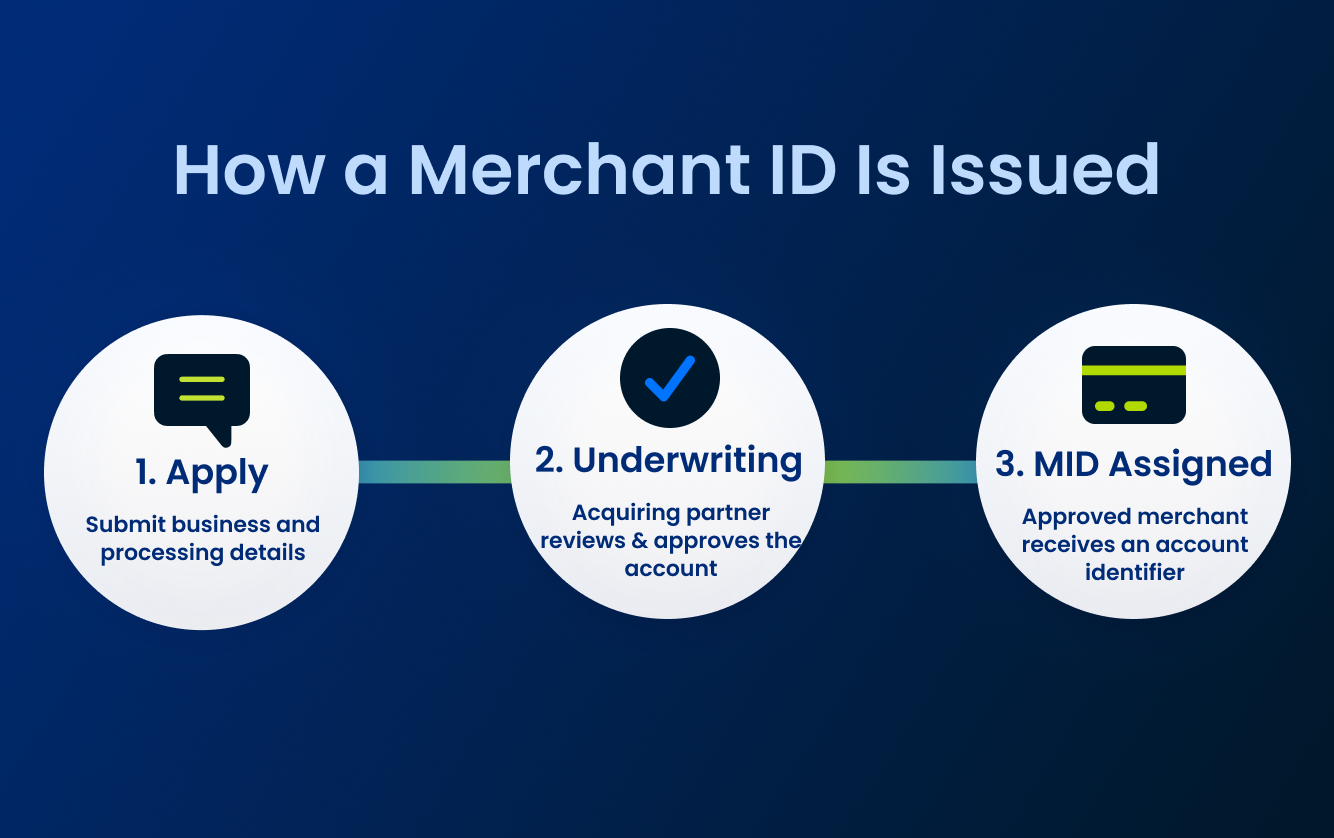
To obtain a merchant ID, a business typically needs to establish a merchant account through an acquiring bank or a payment processor that works with an acquiring partner. Once the account is approved, a MID is assigned to identify the merchant within that processing relationship.
The application process involves underwriting, during which the acquiring partner evaluates the business, its payment activity, and the risks associated with processing its transactions.
What Do You Need to Apply for a Merchant ID?
Requirements vary by provider, but businesses should generally be prepared to submit:
Business information: Legal business name, address, tax identification number, and incorporation or registration documents.
Ownership details: Information and identification documents for business owners or other individuals required for verification.
Processing history: Previous transaction volumes, average transaction values, chargeback activity, and processing statements, when available.
Business model details: Products or services sold, sales channels, fulfillment practices, and any recurring billing or subscription arrangements.
Financial information: Bank account details and, depending on the business and its risk profile, financial statements or other supporting documentation.
Acquirers may also establish processing limits, reserve requirements, or other account conditions based on their underwriting assessment.
How to Obtain Additional Merchant IDs
Businesses that already have a merchant account may be able to request additional MIDs through their existing processing partner or establish a separate relationship with another acquiring provider.
Whether additional MIDs are approved depends on the business's processing needs, risk profile, and the acquiring partner's requirements. An existing merchant account doesn't guarantee approval for another.
Before applying, merchants should clarify what the additional MID will support, whether it requires separate underwriting, and how transactions will be managed across their processing relationships.
For businesses operating multiple MIDs, documenting each account's approved uses, processing limits, and associated provider can help simplify ongoing management and reduce the risk of processing outside agreed terms.
Merchant IDs for High-Risk Sellers
Some ecommerce businesses face additional challenges when obtaining and maintaining merchant IDs because of their industry, business model, or transaction history.
Acquiring banks and payment processors evaluate several factors when determining a merchant's risk level, including chargeback activity, fraud exposure, financial stability, fulfillment practices, and regulatory requirements.
Businesses that may face additional underwriting scrutiny include those operating in:
Subscription and recurring billing: Particularly businesses with free trials, negative-option offers, or higher dispute rates.
Nutraceuticals and wellness: Depending on the products sold, marketing claims, and applicable regulations.
Travel and booking: Where advance payments, delayed fulfillment, and cancellation policies can increase financial exposure.
Financial services: Certain financial products and services may be subject to additional regulatory and processing requirements.
Affiliate and direct-response marketing: Depending on the business model, products promoted, and transaction practices.
Being classified as high-risk doesn't automatically prevent a business from obtaining a MID. However, it may affect which acquiring partners are willing to provide services and the conditions attached to the account.
High-risk merchants may face additional documentation requirements, processing limits, rolling reserves, higher fees, or more frequent account reviews.
Managing Multiple MIDs as a High-Risk Merchant
For high-risk businesses, maintaining more than one approved acquiring relationship may provide additional processing flexibility and reduce dependence on a single provider.
However, multiple MIDs aren't a workaround for excessive chargebacks, fraud monitoring, or account restrictions. Acquirers and card networks may evaluate risk across related merchant accounts, and problems affecting one relationship can have broader consequences.
Merchants should work with acquiring partners that understand their business model, maintain accurate disclosures about their products and transaction activity, and monitor account performance against applicable requirements.
Ultimately,the value of multiple MIDs depends on the health of the accounts behind them, not simply the number of accounts a business maintains.
Merchant Accounts vs. Payment Facilitators: What's the Difference?
Not every ecommerce business needs a dedicated merchant account to accept card payments. Some use payment facilitators (PayFacs), which allow businesses to process transactions through a sponsored merchant arrangement rather than establishing a traditional merchant account directly with an acquiring partner.
Under this model, merchants are typically onboarded as submerchants. They may receive account identifiers for tracking and reporting, but these aren't necessarily equivalent to a dedicated MID issued under a traditional merchant account arrangement.
Payment facilitators can offer simpler onboarding and a more streamlined payment setup, making them attractive to businesses with relatively straightforward processing needs.
However, the right model depends on the merchant's business, risk profile, and payment requirements.
What Should Merchants Consider When Choosing a Payment Model?
Businesses evaluating a PayFac arrangement versus a dedicated merchant account should consider:
Underwriting and eligibility: PayFacs and traditional acquiring providers both assess merchant risk, although their onboarding processes and requirements may differ.
Processing limits and restrictions: Both models can impose transaction limits, reserve requirements, and restrictions on certain products or business activities.
Account stability: Payment providers may suspend processing, hold funds, or terminate accounts under applicable agreements and risk policies. A dedicated merchant account doesn't eliminate these possibilities.
Operational flexibility: Businesses managing multiple brands, regions, or acquiring relationships may need processing arrangements that support more complex requirements.
For merchants with higher processing volumes, specialized business models, or multiple acquiring relationships, dedicated merchant accounts may offer greater flexibility depending on the provider and contractual terms.
The goal isn't necessarily to avoid payment facilitators. It's to choose a processing model that supports the business's current needs and provides an appropriate foundation for future growth.
How To Maintain Merchant ID Health
Obtaining a merchant ID is only the first step. Keeping the associated merchant account in good standing requires ongoing attention to transaction activity, risk management, and the requirements established by your acquiring partners.
Excessive disputes and fraud can put a merchant account at risk, but they aren't the only factors that matter. Acquirers may also monitor processing volumes, refund activity, financial stability, and whether transactions align with the business model and limits approved during underwriting.
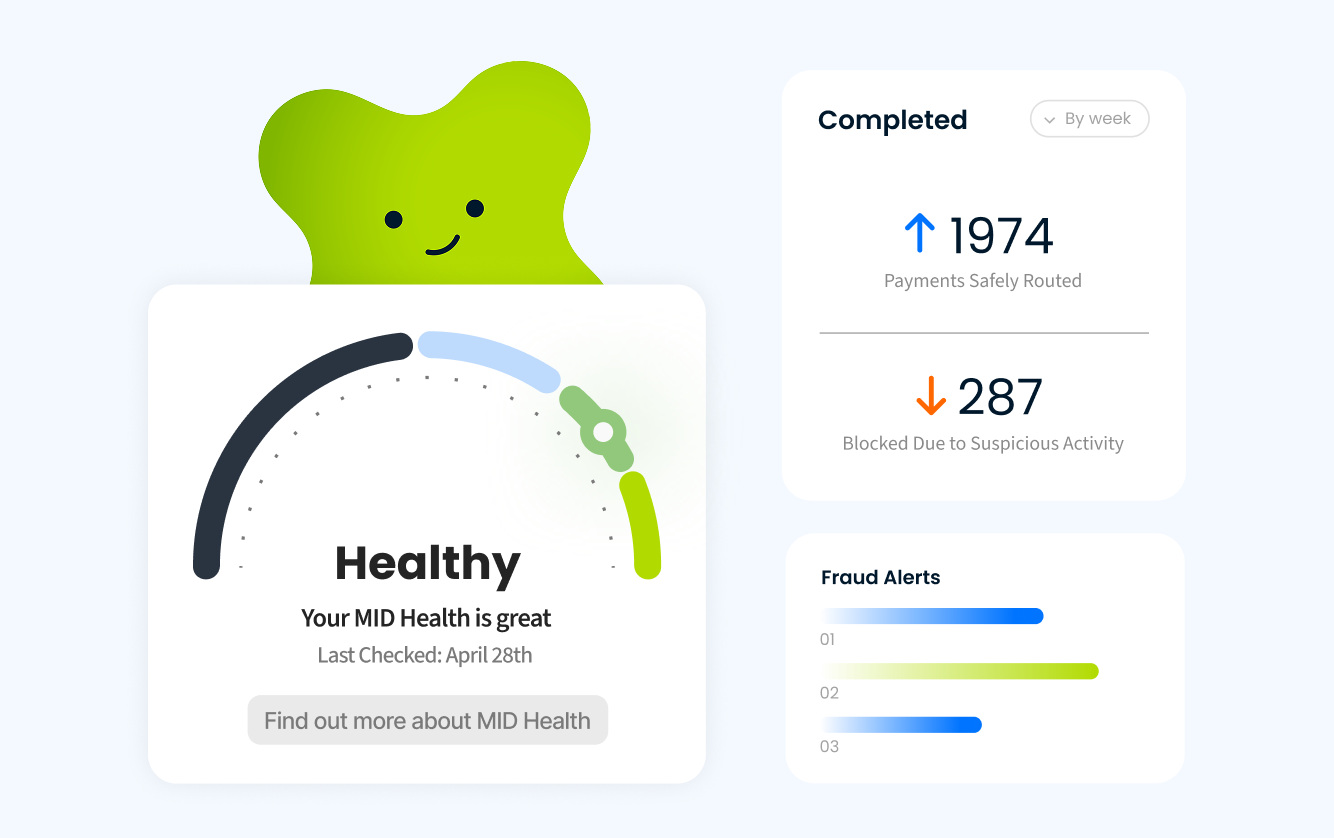
For businesses managing multiple MIDs, monitoring each account is particularly important. Processing activity, contractual requirements, and risk exposure can vary between acquiring relationships. Maintaining visibility across those accounts helps merchants identify potential issues early and address them before they threaten payment operations.
A strong MID management strategy should focus on three areas: understanding card network monitoring requirements, reducing preventable disputes and fraud, and maintaining compliance with acquiring agreements.
Mastercard MATCH Pro: What Merchants Need to Know
Losing a merchant account can make it more difficult to establish new payment processing relationships, particularly if the termination involves fraud, excessive disputes, or violations of card network rules.
Mastercard's MATCH Pro (Member Alert to Control High-Risk Merchants) is a database that helps acquiring institutions identify merchants and related parties previously reported for certain account termination reasons.
A MATCH Pro listing can affect a merchant's ability to obtain new processing services, but it doesn't automatically mean the business is permanently prohibited from accepting card payments.
Why Might a Merchant Be Added to MATCH Pro?
Acquirers report merchants to MATCH Pro when applicable Mastercard listing criteria are met. These can include circumstances involving:
Excessive chargebacks or fraud
Account data compromise
Payment Card Industry Data Security Standard (PCI DSS) noncompliance
Illegal transactions or other qualifying violations of payment network requirements
Not every merchant account closure results in a MATCH Pro listing. Reporting depends on the reason for termination and whether it meets the applicable criteria.
Merchants should also distinguish MATCH Pro from card network monitoring programs, such as Visa's Acquirer Monitoring Program (VAMP). These programs serve different purposes, but both reinforce the importance of managing disputes, fraud, and compliance across payment operations.
How to Reduce MATCH Pro Risk
The most effective approach is to maintain healthy processing practices and address potential issues before they lead to account termination.
Merchants should regularly review dispute and fraud activity, follow their acquiring agreements, maintain applicable security controls, and respond promptly to requests from processing partners.
For businesses operating multiple MIDs, these practices should extend across all acquiring relationships. Opening additional merchant accounts doesn't erase a problematic processing history or guarantee protection from network-level consequences.
Beyond MATCH Pro, merchants should also watch Mastercard's evolving fraud and dispute monitoring requirements.
How Could Mastercard's New Monitoring Rules Affect Your Business?
Mastercard's Global Merchant Audit Program (GMAP) takes effect in April 2027. Use our free simulator to estimate your potential risk tier and financial assessments based on your Mastercard transaction, fraud, and dispute data.
Visa's Acquirer Monitoring Program (VAMP) monitors fraud and dispute activity across the Visa payment network. While the program primarily holds acquirers accountable for managing risk, merchants can also face consequences when their transaction activity exceeds applicable thresholds. You can calculate your risk with our VAMP Risk Simulator.
For businesses managing multiple merchant IDs, VAMP reinforces an important point: distributing transactions across different MIDs doesn't eliminate fraud and dispute risk or exempt accounts from network monitoring.
Maintaining healthy processing relationships requires visibility into dispute and fraud activity, along with an understanding of the requirements established by each acquiring partner.
For a closer look at the program's requirements, monitoring metrics, and thresholds, read our dedicated VAMP guide.
Prevent Chargebacks to Protect Merchant Account Health
Chargebacks are more than a customer service issue. Excessive disputes can put merchant accounts at risk, potentially leading to increased fees, additional monitoring, processing restrictions, or account termination.
For businesses managing multiple merchant IDs, monitoring dispute activity across each processing relationship is especially important. Different acquiring partners may have their own reporting requirements and risk thresholds, while card network monitoring programs can impose additional requirements.
Reducing chargebacks starts with addressing the issues that cause customers to dispute transactions. Important practices include:
Clear billing and subscription terms: Make pricing, renewal schedules, cancellation policies, and other purchase conditions easy to understand.
Recognizable billing descriptors: Help customers identify charges on their statements to reduce confusion-driven disputes.
Responsive customer support: Make it easy for customers to resolve billing, fulfillment, or product issues before escalating to their bank.
Accurate product information and fulfillment: Set realistic expectations through marketing, product descriptions, and delivery communications.
Dispute monitoring and prevention tools: Consider alerts and pre-dispute resolution services that may help merchants resolve eligible disputes before they become chargebacks.
While dispute alerts and representment services can play a role in managing chargebacks, they aren't substitutes for addressing underlying causes. Their effects on reported dispute metrics also depend on the relevant network rules and how disputes are resolved.
Protect Your Merchant Accounts Against Payment Fraud
Payment fraud can threaten merchant account health, leading to financial losses, increased scrutiny from acquiring partners, and potential card network monitoring consequences.
For businesses operating multiple MIDs, fraud prevention requires visibility across payment activity and a consistent approach to identifying suspicious transactions. While each acquiring relationship may have different requirements, distributing transactions across accounts doesn't eliminate the underlying risk.
Several tools and practices can help merchants reduce exposure to fraudulent transactions:
Card Verification Value (CVV): Helps verify that a purchaser can provide the card's security code. While useful, CVV verification doesn't guarantee a transaction is legitimate or that the purchaser physically possesses the card.
Address Verification Service (AVS): Compares billing address information against issuer records where supported. Mismatches can indicate potential risk but shouldn't automatically be treated as proof of fraud.
3D Secure (3DS): Adds an authentication layer to eligible online card transactions. Depending on the transaction and issuer's assessment, authentication may occur without additional customer interaction or require a verification challenge.
Device and behavioral signals: Can help identify suspicious activity, such as unusual purchasing patterns or repeated transactions associated with the same device.
Secure payment integrations: Proper authentication, access controls, and secure handling of payment data help reduce unauthorized access and transaction abuse.
No single fraud prevention method is sufficient on its own. Merchants should evaluate these controls together, balancing fraud prevention with the potential impact of unnecessary transaction declines and customer friction.
Maintaining appropriate security practices, monitoring fraud trends, and working with acquiring partners to address emerging risks can help protect merchant accounts and support more stable payment operations.
What Happens if Your Merchant Account Is Terminated?
Losing a merchant account can disrupt payment acceptance, particularly for businesses that rely on a single acquiring relationship. Depending on the reason for termination, merchants may also face withheld funds, additional underwriting scrutiny, or difficulty establishing new processing relationships.
However, account termination doesn't automatically mean a business is prohibited from accepting payments or will be reported to Mastercard's MATCH Pro database. The consequences depend on the circumstances of the closure, applicable network rules, and the merchant's processing agreements.
What Should You Do if a Merchant Account Is Closed?
If your acquiring partner terminates your account, take the following steps:
Understand the reason for termination. Contact your processor or acquiring partner to clarify why the account was closed, whether any funds are being held, and what contractual obligations remain.
Review your processing activity. Examine recent disputes, fraud trends, transaction volumes, and other potential issues that may have contributed to the decision.
Address underlying problems. If the termination resulted from excessive disputes, compliance concerns, or processing outside approved terms, document the corrective actions you've taken.
Discuss your options with acquiring partners. Depending on the circumstances, you may be able to seek reconsideration or apply for a new merchant account. Approval is not guaranteed and may require additional underwriting.
Evaluate your remaining processing relationships. If you operate multiple MIDs, confirm that other accounts remain in good standing and that any continued processing complies with their approved terms.
Can Multiple MIDs Help Prevent Payment Disruptions?
Having multiple approved merchant accounts may reduce dependence on a single processing relationship. If one account becomes unavailable, another may provide an alternative for eligible transactions.
However, additional MIDs don't guarantee uninterrupted processing. Acquiring restrictions, network rules, shared risk exposure, and technical configuration can all affect whether transactions can be processed through another account.
Businesses should establish appropriate processing relationships and contingency plans before disruptions occur, rather than relying on additional MIDs as a solution after an account has been terminated.
Build a More Flexible Payment Infrastructure
Managing multiple processing relationships? See how Sticky.io can help coordinate payment connections and support a more resilient checkout experience,
Manage Multiple MIDs With a More Flexible Payment Strategy
Maintaining healthy merchant accounts is essential, but it's only one part of managing a reliable payment operation. As ecommerce businesses expand across products, markets, and acquiring relationships, coordinating their payment infrastructure becomes increasingly important.
Sticky.io's payment orchestration capabilities help merchants manage transactions across configured payment gateways and processing connections. With capabilities such as transaction routing and cascading, businesses can build more flexible payment flows while maintaining visibility into processing activity.
For merchants operating multiple MIDs, this can help simplify the operational complexity of working with different payment providers. However, routing and cascading remain subject to supported integrations, account configurations, and the requirements of each acquiring partner.
A stronger payment strategy isn't simply about adding more MIDs. It's about maintaining healthy acquiring relationships and having the infrastructure to make effective use of approved processing options.
*Updated November 2026 for content and quality.
Make the Most of Your Merchant IDs
Having multiple merchant IDs is only part of the equation. Managing transactions across different processing relationships takes the right technology and strategy.
See how our Sticky.io can help you coordinate payment connections, streamline operations, and make better use of your approved MIDs.
Companies can navigate an economic downturn by protecting cash flow, improving operational efficiency, prioritizing customer retention strategies, optimizing supply chains, using technology strategically, recovering lost revenue, and planning for multiple economic scenarios.
Everything direct-to-consumer merchants and retail brands need to know about unlocking the power of subscription business models and keeping hard-earned customers happy.
Managing merchant IDs is about more than accepting payments. For ecommerce businesses operating across multiple accounts, processors, or markets, the right approach can help reduce risk and strengthen payment continuity.